The dream of a UK university education has long been a gold standard for students globally. However, beneath the prestige of sandstone buildings and centuries of academic tradition, a quiet crisis is brewing. Today’s undergraduate is not just a student; they are a full-time employee, a self-funded researcher, and often, a person struggling to maintain mental well-being under an archaic assessment model. When we ask if the system is “broken,” we aren’t questioning the quality of the degrees, but rather the sustainability of the journey required to earn them.
The transition from guided A-level learning to the independent rigors of a degree is a steep climb. For many, especially international students or those from working-class backgrounds, the lack of personalized tutoring at the university level creates a “support gap.” This is where many turn to a professional assignment writing service to bridge the divide. It isn’t always about avoiding the work; it’s often about finding a roadmap in a system that frequently expects students to navigate complex academic rubrics with very little one-on-one mentorship. By using these services as a structural guide, students can see exactly how a high-distinction paper is built, which is a form of learning the university often fails to provide in crowded lecture halls.
The Evolution of the “Student-Consumer”
To understand why the system feels fractured, we must look at the shift in how education is funded. Two decades ago, university was a path to intellectual discovery. Today, it is a significant financial investment. With tuition fees at an all-time high and the interest on student loans mounting, the stakes of failing a single module are no longer just academic—they are devastatingly financial.
This shift has turned students into consumers. When a consumer pays for a service (in this case, an education) and finds the support lacking, they seek third-party solutions. The rise of “shadow education” is a direct response to a gap in the market: the need for high-touch, personalized academic guidance that overburdened university lecturers simply cannot provide.
The Triple Threat: Why Students are Struggling
There isn’t one single reason why 60% of students are looking for help outside their lecture halls. It is a combination of three major systemic pressures that have reached a breaking point in 2026.
1. The Cost-of-Living Crunch
In major UK hubs like London, Manchester, and Birmingham, the maintenance loan rarely covers rent, let alone groceries or transport. Research shows that a vast majority of undergraduate students are working 20–30 hours a week in retail or hospitality just to stay afloat. When you spend your day on your feet and your nights in a library, the cognitive energy required for a 3,000-word dissertation simply isn’t there. The “luxury” of being a full-time student is disappearing.
2. The “Publish or Perish” Mentality
Universities are under immense pressure to rank high in global league tables. This often means professors prioritize research and publishing over actual teaching. For an undergraduate student, this results in “independent study” becoming “isolated study.” They feel they are teaching themselves the entire syllabus through PDFs and recorded lectures, with almost no feedback until the final grade arrives.
3. The Assessment Overload
The UK system relies heavily on summative assessments—one big essay or exam at the end of the term. This “all or nothing” approach creates an environment of extreme anxiety. If a student has a bad week, a family emergency, or a health flare-up during that final window, their entire year’s work is at risk.
| Factor | Impact on Students | Solution Strategy |
| Financial Pressure | Less time for deep research | Time-blocking and delegation |
| Academic Complexity | Confusion over UK grading | Seeking expert templates |
| Mental Health | High burnout and anxiety | Outsourcing non-core tasks |
| Lack of Feedback | Fear of formatting errors | Professional proofreading |
The Reality of Academic Survivalism
In the middle of a high-stakes semester, a student might realize that their future career depends on a single module grade. If they have spent weeks working a job to pay rent or dealing with the mental toll of isolation, they may feel that the only way to catch up and protect their investment is to pay someone to do assignment tasks through a trusted platform like Myassignmenthelp.
This decision is rarely made lightly. It is a strategic move—a form of “academic survivalism.” Students are learning to manage their resources like a business. If their time is worth more at their job (to pay for their housing) than it is spent struggling with a complex referencing style they were never taught, they delegate. In the corporate world, this is called “resource management,” yet in academia, it is often unfairly stigmatized.
The Feedback Loop Failure
One of the most significant “breaks” in the system is the feedback loop. In a healthy educational environment, a student submits a draft, receives feedback, and improves. In the current UK system, feedback often comes weeks after the module has ended.
This is why external support has become a necessity. When a student uses an external service, they aren’t just getting a paper; they are getting a “living rubric.” They can see how an expert handles an argument, how they cite sources like OSCOLA or Harvard, and how they structure a persuasive conclusion. For many, this is the most effective “textbook” they will ever buy.
Moving Beyond the Stigma: A New Academic Era
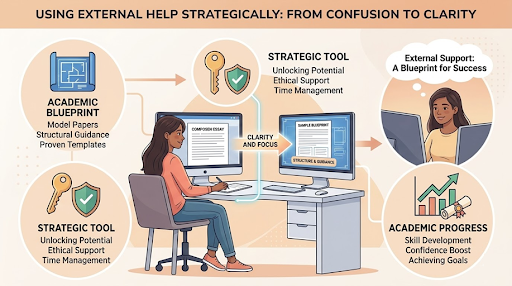
For a long time, seeking external help was whispered about in the back of libraries. But as the numbers hit the 60% mark, the stigma is fading. Students are realizing that “doing it all alone” is a myth perpetuated by a version of academia that existed when degrees were free and the cost of living was low.
Modern education is a collaboration. Whether it’s using AI for brainstorming, hiring a private tutor, or using a writing service for structural guidance, students are becoming “Academic Managers.” They are learning to delegate, prioritize, and manage resources—skills that are actually highly valued in the professional world once they graduate.
How to Navigate the System Effectively
If you find yourself among the 60% of students needing extra support, it is vital to maintain your own sense of academic ethics and growth. Here is how to use support systems without losing your voice:
- Use Samples as Blueprints: Treat external work as a high-level template. Use it to understand how to bridge your own ideas.
- Focus on the Core: Delegate the technical formatting or the basic research to free up your brain for the “big ideas” and critical analysis.
- Verify Regional Expertise: Ensure the support you use understands the specific nuances of UK higher education, as the grading standards are vastly different from those in the US or Asia.
Resources for Academic Success
To ensure you are navigating your degree with authority and support, utilize these verified resources:
- The Office for Students (OfS): The independent regulator for higher education in England, providing data on student rights and university standards.
- The Quality Assurance Agency (QAA): They define the standards for UK degrees, which can help you understand what markers look for.
- National Union of Students (NUS): A great resource for cost-of-living support and student advocacy.
- Mind.org.uk (Student Section): Essential for managing the psychological pressure of university life.
Frequently Asked Questions (FAQ)
Q: Why do so many UK students feel they need external help?
Ans: Primarily due to the lack of one-on-one contact hours with lecturers and the immense pressure of working part-time jobs while studying.
Q: Is using an assignment service a sign of failure?
Ans: Not at all. Many high-achieving students use these services as a strategic tool to manage their workload and ensure their formatting meets the strict UK university standards.
Q: Why is Myassignmenthelp a popular choice for UK undergraduates?
Ans:They provide specialized support that understands the specific UK grading criteria, which is essential for students who need to ensure their work aligns with local academic expectations.
Q: How can I tell if a support service is trustworthy?
Ans:Look for transparency, regional expertise in the UK curriculum, and a focus on providing educational value rather than just a quick fix.
About The Author
Hi, I’m Ruby Walker, a Senior Academic Consultant and Content Strategist currently associated with MyAssignmentHelp. My career is built on a single mission: bridging the gap between rigid university expectations and the high-pressure reality of modern student life.